
This page provides detailed information about the exam, including an introduction to SASMO knowledge points, exam question types, exam syllabus, and frequently tested question types.
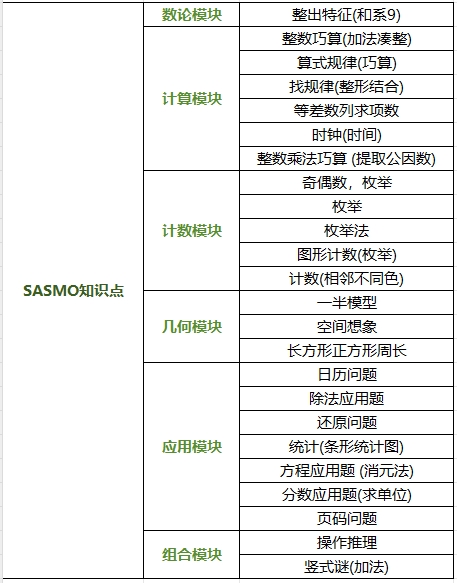
I. Introduction to SASMO Knowledge Points
II. Exam Format
1. Section A: 15 multiple-choice questions, total 30 points (2 points each). Correct answer earns 1 point, unanswered question earns 0 points, and incorrect answer deducts 1 point.
2. Section B: 10 short-answer questions, total 40 points (4 points each). Correct answer earns 1 point, unanswered question earns 0 points, and incorrect answer does not deduct points.
3. Total score: 85 points. (To avoid negative scores, each candidate starts with 15 points.)
Note: Calculators are not allowed during the entire exam.
III. Examination Syllabus
| grade | suject |
|---|---|
|
Grades 1-4 |
Arithmetic and Statistics |
| Geometry and Measurement | |
| Solve word problems using modeling methods. | |
| Unconventional problem solving(Including number patterns, separability tests, spatial visualization, logic problems, and simple cryptography) | |
|
Grades 5-6 |
Arithmetic and Statistics |
| Geometry and Measurement | |
| Solve word problems using modeling methods. | |
| Unconventional problem solving(Including digital patterns, separability tests, spatial visualization, logic problems, and cryptography) | |
|
Grades 7 |
Arithmetic and Algebra |
| Geometry, graphics and measurement | |
| Statistical data | |
| Unconventional problem solving(Including digital patterns, separability tests, spatial visualization, logic problems, and cryptography) | |
|
Grades 8 |
Arithmetic and Algebra |
| Geometry, graphics and measurement | |
| Pythagorean theorem | |
| Statistical data | |
| Unconventional problem solving(Including digital patterns, separability tests, spatial visualization, logic problems, and cryptography) | |
|
Grades 9-12 |
Arithmetic and Algebra |
| Geometry, graphics and measurement | |
| Pythagorean theorem and trigonometry | |
| Statistics and Probability | |
| Unconventional problem solving(Including digital patterns, separability tests, spatial visualization, logic problems, and cryptography) |
IV. Frequently Tested Question Types
Seven frequently tested question types: Calculation and problem-solving, graphic recognition, application and practice, abstract generalization, logical reasoning, spatial imagination, and creative thinking.
1. Application and Practice Questions (approximately 40%): Primarily test age-related problems, periodic problems, sum-difference-multiple problems, and date/calendar questions.
2. Graphic Recognition (approximately 20%): Often tests comparison, sequencing, manipulation, and three-dimensional shapes.
3. Logical Reasoning Questions: These questions are flexible and varied, closely related to real-world problems, testing students' practical application abilities and logical thinking skills.
4. Creative Thinking Questions: These are present throughout all question types, including graphic problems, application problems, and logical reasoning questions, and are a challenging aspect of the exam.